



By Robin Mamlet and Christine VanDeVelde, Special for USA TODAY
In the past, when students received the fat envelope, the suspense of the college application process was largely over. That's not necessarily so this year. Because in the 2009 college admission season — with the largest high school graduating classes in history, record numbers of applications and dwindling economic resources — colleges simply don't know how many students are going to be able to accept their offers.

To cope with that uncertainty, many colleges are admitting more students than in the past. If they find they have over-enrolled their incoming class, they may be more likely to revoke an offer of admission to those who haven't maintained top grades or fallen short in some other way. (Final grades were cited by 69% of colleges that revoked admission offers in 2007; disciplinary problems accounted for 25%, says the National Association for College Admission Counseling.) Other colleges are admitting fewer students and counting on pulling heavily from their wait-list. In deciding who should come off that list, a primary consideration will be a strong senior year. Those who slack off will find themselves last in line.
Economic exacerbation
"The stakes have compounded exponentially this year because of the uncertainty we're facing," says Doug Christiansen, dean of admission at Vanderbilt University in Nashville.
Though colleges have always reviewed the final academic records of incoming classes, this year they will scrutinize them more thoroughly, officials say. Admission departments will double-check for drops in grades, absenteeism and situations in which, for example, a student's application said he was taking three advanced placement classes, but he later dropped two. They also will watch for red flags that arise from lapses in judgment or integrity, such as cheating, plagiarism, drinking or drug use.
How many students may have admission withdrawn this year? With their predictive models not working in this admission cycle, colleges just don't know yet. The University of California projects that about 50 admission offers may be withdrawn at each of nine campuses, says Sue Wilbur, director of undergraduate admissions. But some campuses could issue more. "All campuses are very carefully managing their numbers to come in on their enrollment targets," she says. When officials say in their admission letter that enrollment is contingent on maintaining senior-year grades, they mean it.
Being proactive can help
When admission is rescinded, the news probably will come at a difficult time. Though students commit to a school on May 1 and release other offers, colleges don't see final transcripts until after graduation and are at the mercy of high schools on when records arrive. Students may learn as late as August they have no place to go in the fall.
But there is something students can do — if they act before the letter revoking admission arrives. If there is a problem, a student should inform the college where he has been accepted or wait-listed. It is incumbent on the student — not the parent — to take the initiative, call the admission department, explain the problem as candidly as possible and describe what is being done to remedy it. A school often will look more kindly on such news when informed well before viewing the final transcript.
"Universities will find out," Christiansen says.
Colleges do consider extenuating circumstances such as family emergencies or illness, and, when appropriate, may suggest summer school or deferring enrollment for a year. "Colleges are in the business of education, not punishment," says Susan Dean, director of college counseling at Castilleja School in Palo Alto, Calif., an elite secondary school for girls. "Anything they can do to assist a student, they are going to try to do."
If a student doesn't self-report and has admission rescinded, there is usually little he can do. Schools are loath to remake such decisions. Almost all schools include language in acceptance letters that makes admission contingent on performance through the end of the senior year.
That conditional language constitutes a fair warning — and officials advise high school seniors to take it seriously, particularly this year.
DANGER SIGNS AND WHAT TO DO IF YOU TRIP UP
Parents should encourage their college-bound children to talk to them right away if any of these symptoms occur:
• A significantly lower grade in one or more courses
• A decline in overall GPA
• Dropped academic courses
• Abandoning extracurricular activities, such as a sports team or music lessons
• Disciplinary action for behavioral issues
• Academic misconduct, including cheating or plagiarism
• Increased absences or tardiness
• Suspension for drug or alcohol use
Tell on yourself: A good rule of thumb is that if a family is talking about any of these issues, the student should also be talking about it with the admissions department where they have been accepted or are wait-listed.
The earlier a student self-reports, the better. That way, the school can either advise the student about what they can do to sustain an offer of admission or inform the student upfront that the offer will be withdrawn, so there will be time to explore alternatives.
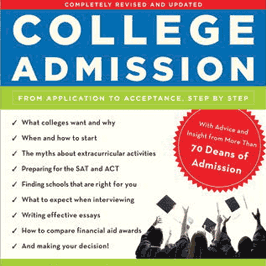
Robin Mamlet is former dean of admissions at Stanford University, Swarthmore College and Sarah Lawrence College. She is now with Witt/Kieffer, an executive search firm for the non-profit/education sector. Christine VanDeVelde is a journalist who writes frequently on the college application process. They are writing a book on admission.