



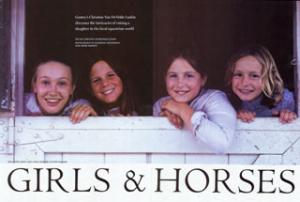
Gentry's Christine VanDeVelde discusses the intricacies of raising a daughter in the local equestrian world
Velvet's dreams were blowing about the bed. They were made of clouds but had the shapes of horses. Sometimes she dreamed of bits as women dream of jewelry… Sometimes she walked down an endless cool alley in summer, by the side of the gutter in the old red brick floor. On her left and right were open stalls made of dark wood… The horses turned their heads to look at her as she walked. They had black manes hanging like silk as the thick necks turned. These dreams blew and played round her bed in the night and the early hours of the morning… -- National Velvet, Enid Bagnold
Many have tried to explain the origins of horse worship in young girls. It is freedom, Freudian, a spiritual experience, a partnership with an animal of great grace and power. I cannot claim to understand the appeal, but I know it is a passion. In our house, it started when my daughter was three years old and wanted to stop and pet every horse she saw. We thought it was a passing fancy. I am here to tell you that passing fancies lead to very real commitments.
We quickly progressed from weekly lessons when she was five to a half-lease on a pony, to owning a pony, to at one point, owning a horse and a pony and leasing yet another horse. And if I can't tell you what the appeal is for young girls, I can tell you what the appeal is for parents. The focus, assurance and physical mastery this sport develops in a girl are wonderful to behold. As Diane Ackerman wrote in A Natural History of Love, "At its highest level, riding becomes art: it demands the discipline of Zen, the taut muscles of dance and the timing of gymnastics."
Seeing a 10-year-old girl calmly and forcefully control a 1,000-pound, 16-hands high thoroughbred will reassure any father that she will later in her life handle boys with aplomb. And most mothers would vastly prefer their daughter spend Saturday hacking around the arena and mucking out stables rather than hanging out at the mall. I am talking of daughters here, by the way, because that has been our experience, but also, because, at the beginning and intermediate levels of riding, it's almost exclusively a girl's world.
So, if your daughter's notebooks are covered with horse stickers, her favorite bedtime reading is Black Beauty, and she has started to build a website decorated with prancing ponies, you will probably be looking for riding lessons soon enough. When our daughter started riding, my husband had never sat on a horse and my experience consisted largely of riding bareback on the quarterhorses in the fields of my grandparents' Illinois farms. These last seven years have been a constant learning process. While it is a marvelous thing for a child to have a passion, riding is not risk-free and it is a very expensive pursuit, in terms of both money and time. It has, at times, been a wild and emotional ride through a world with its own rules, rites, rituals, and wardrobe.
Your daughter's real desire to ride is the sine qua non. "Desire is the greatest gift," says John Charlebois, a lifelong equestrian and head trainer at Charlebois Farms in Menlo Park. "It's like talent."
The type of riding that is most popularly pursued by young girls here on the Peninsula is English riding -- hunters, jumpers and equitation. Eventing, dressage, saddle seat, western riding and vaulting are available here, but are not as popular. English riding is a form of show riding -- the sport of riding a pony or horse through a course filled with fences. But long before she jumps her first oxer, your daughter will learn to keep her balance on horseback and to use her legs, arms, hands, and her seat to communicate with the horse. Mastering the basics of balance at the walk, trot and canter usually takes about two years.
The key is good instruction. And, as far as I'm concerned, the key to good instruction is safety. A program should insist on the proper attire and equipment. There should be a professional atmosphere. The physical environment should be well-ordered and safe; many barns are fire traps or have a lot of transient traffic. As Lenny Marconi, trainer at Bridgeport Farms in Woodside, says, "I cannot emphasize enough the importance of the safety of the environment in which you turn your child loose. You can't be too careful. Ask questions. Ask around about a facility and its record."
The trainer is crucial to a successful program. Both parent and child should feel comfortable with the trainer. After all, he or she will be mentor, coach, teacher and safety officer in loco parentis. Even better, the child and her trainer should have chemistry. Have your child take a preliminary lesson. Confidence is crucial in riding and is developed in that relationship and through a safe and appropriate lesson program. "Children have to be handled sensitively," says Marconi. "They need to have 100% confidence in your training. You have to believe in them and they have to believe in you."
Charlebois says the best advice he can give a parent is to "find someone you can work with that you totally trust." When interviewing a trainer, ask them to assess their strengths and weaknesses as a teacher and trainer, as well as the strengths and weaknesses of their program, its cost structure, and their approach to developing not only skills, but sportsmanship.
A parent should also determine whether the focus of a program is aligned with their own goals. "If the child just wants to have fun and learn how to ride," says Gwyn Gordon of Cardinal Farms, "a school program is completely appropriate and is an economical choice. If the child wants to compete, it's important to be with an instructor who has the experience and desire to help them to succeed. Most trainers have a pretty clear focus, know what they enjoy teaching and know the type of customer that will fit in with their existing client base." And, remember, the best programs train the horse and the rider.
Finally, for most girls, riding is also a social experience. Every barn -- like every school -- has its own sub-culture, with its own style and ethos. So, you will want to choose a barn where there are other girls that your daughter will enjoy being with.
Once she starts mastering the basics, it won't be long before your daughter will want to start collecting show ribbons to ring her room. In hunter/jumper and equitation competition, the horse and rider are judged on their form and style as they jump a series of fences. Initially, competition might consist of a Saturday afternoon event at your daughter's stables. In our experience, it soon progresses to major investments of travel, time, money and effort, in pursuit of points on the high-octane "A" circuit.
Most girls who are active at the intermediate level of riding show about once a month, at "A" shows within the state of California, from Indio and Del Mar to Pebble Beach and Atherton. (More committed riders may go on to do the indoor shows on the East coast, which is a whole other level of competition.) At a show, they will usually participate in at least four events a day, from Thursday through Sunday, at a cost of about $2,000 per show.
If your daughter wants to compete, therefore, you will almost certainly have to consider leasing or buying a pony or horse. Leasing a pony can start at $500 a month and go up to $6,000. A top-of-the-line show horse can cost upwards of $200,000. But a reliable show horse can also be had for as little as $20,000.
Both Marconi and Charlebois strongly emphasize the importance of finding a "suitable" horse for a child. In other words, a horse that is suitable to achieving your child's riding goals -- a mount that is safe, sound, athletic, competitive and rideable. In the purchase of a horse, you are largely reliant on your trainer -- yet another reason to have complete trust in him -- or her. If you know you are going to be in the market for a horse, make sure you find out if the trainer at the barn you are considering has had experience purchasing the kind of horse you are seeking. And when you do buy, be sure to invest in a thorough pre-purchase medical examination by an independent veterinarian. It's not worth it to cut costs here.
The sport of riding, of course, has its own version of the "Little League parent" haunting the "A" circuit -- the "pony moms". Start with riding's traditional connotations of wealth and status, and the outlays of time and money it requires, then add in public competition, and the result is the potential for some parents to become over-involved -- a problem in many youth sports today. When the child follows the parent's lead, healthy competition devolves into contention. My best advice is to carefully choose your program, make sure the trainer has a game plan for handling such occurrences, and when these things happen, as they will, make them a life lesson for your daughter. Just remember that what Vince Lombardi really said is, "Winning isn't everything, but wanting to win is."
Healthy competition, in my opinion, is, in fact, a wonderful thing -- for girls, in particular. Growing up during the ‘60s, there were few opportunities for girls to compete in sports. I envied my brothers' wins and losses in basketball, football and baseball. Competition teaches children about the ups and down in life, to set goals, to work hard, to bounce back from adversity and failure. It develops character.
We now also know that participating in sports increases young women's self-esteem, that high school girls who participate in sports have higher grades than non-athletes, and that they are more likely to aspire to be leaders and less likely to experience depression. Girls who participate in sports are 92% less likely to get involved with drugs and are 80% less likely to have an unwanted pregnancy.
It's going a little too far to think of these young riders as future Olympians. The average age of an Olympic equestrian is around 36 -- it's a sport that rewards judgment and experience (and also the only Olympic sport where men and women compete against each other.) But if your daughter sticks with the sport of riding, there could be other important rewards down the line. In 1999, the NCAA voted to recognize riding as an "emerging sport", which will eventually lead to the recognition of equestrian competition as a championship varsity sport. (Prior to this time, most collegiate equestrian teams had "club" status; in other words, no significant funding or scholarship opportunities.)
Equestrian sports, with its large contingent of women, would go a long way toward helping colleges solve their Title IX dilemma, the 1972 federal education amendment that prohibits sex discrimination in federally-funded education, including athletics. In one of the NCAA's latest studies, 70% of sports scholarship monies went to men. And, according to the Women's Sports Foundation, 80% of U.S. educational institutions still fail to provide sufficient sports opportunities for women. As a championship varsity sport, riding could provide many new opportunities and scholarship monies for young women.
According to Ann Baer, Associate Athletic Director at Oklahoma State University, equestrian sports will achieve full varsity status when 40 schools sponsor varsity teams. They are almost halfway there now, with schools, such as Brown University, Dartmouth College, Cornell University, University of South Carolina, Kansas State and Texas A & M, among those currently offering intercollegiate women's equestrian teams.
In all honesty, even with a full scholarship to Cornell, riding is not a breakeven proposition economically, but it can be a lifelong sport that will stand your daughter in good stead in everything else she does. I hope that thought makes your trot down the bridle path a little easier to sit.
The following stables have school ponies and/or horses available for lessons and are therefore appropriate for beginners and non-owners. The cost of lessons ranges from $35 to $60 for a private half-hour to $35 to $60 for a 1-hour group lesson with 3 to 6 people. Some of these facilities also offer intermediate and advanced training and competitive showing for those who own a pony or horse.
Creekside Stables -- (3639 Alpine Road in Portola Valley) Private, semi-private and group lessons in hunt seat equitation and jumping on ponies and horses. Many of their ponies are available for half-lease. They also offer a Sunday Clinic Series for beginners. Trainer: Meg Finn, (650) 854-4955 or creeksidestables@hotmail.com.
Fremont Hills Stables -- (26941 Purissima Road in Los Altos Hills on the grounds of the Fremont Hills Country Club) Private, semi-private and group instruction in English and Western riding on ponies and horses. All lessons are given on school horses and ponies and the program offers no show schedule. For information: Kate Farley, (650) 948-9980.
J.P. Training Center -- (Portola Farms, 1545 Portola Road in Portola Valley) Schooling program and training in hunters, jumpers and equitation for ponies and horses. Contact trainer, Jan Pearce, or instructor, Sally O'Brien, at (650) 851-0910.
Menlo Circus Club -- (190 Park Lane in Atherton, within the private Circus Club) Private and group instruction in hunters, jumpers and equitation, as well as western and saddle seat, for both ponies and horses. Riding instructor: Liane Lanterman, (650) 322-6700.
Millennium Farm -- (Portola Valley Training Center at 100 Ansel Lane in Menlo Park) Probably the largest pony barn in the area for beginners. But has a very restricted school program, primarily catering to lessees and owners. Private and group lessons in hunters, jumpers and equitation on ponies and horses. Trainers: Jill Hamilton and Nancy Thomas, (650) 854-4657.
Spring Down Equestrian Center -- (725 Portola Road in Portola Valley) Instruction in hunters, jumpers, dressage and equitation. Beginning riders must take private lessons until they can trot securely. Group lessons are available to riders who can walk, trot and canter a horse. Information: (650) 851-1114 or sdecenter@aol.com.
Stanford Equestrian Center -- (Electioneer Road at Campus Drive West on the Stanford University campus) Private and group lessons in hunters, jumpers and equitation for horses. A working student program provides group lessons in exchange for a 5-hour work shift. Program Director: Cheryl Maloney, (650) 322-5713.
Strideaway Farms -- (Stanford Equestrian Center on Electioneer Road at Campus Drive West on the Stanford University campus) Group and private lessons in hunters, jumpers, equitation and dressage for ponies and horses. They strive to offer the opportunity, not usually available, for non-owners to participate in showing when they are ready. Trainer: Nancy Hey, (650) 851-2525 or strideawayfarms@earthlink.com.
Webb Ranch -- ( 2720 Alpine Road in Menlo Park) Private, semi-private and group lessons in English (hunters, jumpers and equitation) and western riding, as well as horsemanship classes and trail riding for horses only. Jumping is not offered past basic instruction. Lesson office: (650) 854-7755.
Woodside Pony Club -- (3375 Tripp Road in Woodside) Meets on weekends from September through June, offering lessons in English riding and horsemanship for children, ages 7 to 21, who provide their own horses. This location also hosts the Woodside Junior Riders, a 10-week summer program in English riding and horsemanship classes for children, ages 6 to 18, who live in the Woodside Fire District. Horses are provided in the Junior Riders program. Information for the Pony Club: (650) 851-7645. Information for Junior Riders: (650) 851-0744.
The following barns train intermediate and advanced riders, who own or lease their own ponies and horses. Training fees average $500 to $700 per month and usually include at least 3 lessons per week. Board, which can run from $500 to $750, and ancillary expenses, such as grooming, shoeing, and feed supplements, are additional. Show expenses, such as entry fees, transportation, and stall rental, are also additional. All of these barns are active in competitive showing at national and regional "A"-rated horse shows.
Aspen Ridge Training -- (Charter Oaks Stables, 880 Runnymeade Road, Woodside) Private and semi-private training in hunters, jumpers, equitation, and horsemanship. Trainer Trudy Exton, a lifelong equestrian and clinician, started Aspen Ridge 14 years ago. For more information: (650) 851-1640.
Bridgeport Farms -- (896 Runnymeade Road in Woodside, and 5580 Red Hill Road in Petaluma) Individual hunters, jumpers and equitation training at all levels on ponies and horses. Trainer Lenny Marconi turned professional and opened the Woodside facility in 2000, after a long and successful career as an amateur rider. His partner, trainer John Bragg, who is principally based in Petaluma, also continues a very successful career as a professional rider. For more information: www.bridgeportfarms.com or (650) 851-2234.
Cardinal Farms -- (3639 Alpine Road in Portola Valley) Hunters, jumpers and equitation training on both ponies and horses. Trainer Gwyn Gordon is a Stanford graduate and a former member and coach of Stanford's equestrian team. She founded Cardinal Farms in 1999. For more information: (650) 704-0402.
Charlebois Farms -- (Portola Valley Training Center at 100 Ansel Lane in Menlo Park) A lifelong equestrian professional, John Charlebois opened this facility in 1995, offering hunters, jumpers and hunt seat equitation training. Charlebois continues as a rider, as well as a trainer, clinician and American Horse Show Association judge. For more information: (650) 854-2607.
*Please note that these lists are a guide for beginning and intermediate children's riding and are not exhaustive. There are numerous other facilities in the area, which offer lessons, training and competitive showing in English riding on ponies and horses.