
"What is the use of a book," thought Alice, "without pictures or conversations?" -- Alice's Adventures in Wonderland, Lewis Carroll
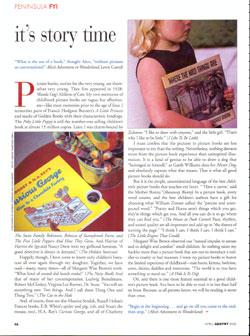
Picture books, stories for the very young, are themselves very young. The first appeared in 1928: Wanda Gag's Millions of Cats. My own memories of childhood picture books are vague, but affectionate -- like most memories prior to the age of four. I do remember Dr. Seuss and stacks of Golden Books with their characteristic bindings. The Poky Little Puppy is still the number-one selling children's book at almost 15 million copies. Later, I was charm-bound by The Swiss Family Robinson, Rebecca of Sunnybrook Farm, and The Five Little Peppers And How They Grew. And Harriet of Harriet the Spy, and Nancy Drew were my girlhood heroines. "A good detective is always in demand." (The Hidden Staircase)
Happily, though, I have come to know early children's literature all over again through my daughter. Together, we have read -- many, many times -- all of Margaret Wise Brown's work. "What kind of sound did lunch make?" (The Noisy Book) And that of many of her contemporaries: Ludwig Bemelmans, Robert McCloskey, Virginia Lee Burton, Dr. Seuss. "You will see something new. Two things. And I call them Thing One and Thing Two." (The Cat in the Hat)
And, of course, there are also Maurice Sendak, Russell Hoban's Frances books, E.B. White's spider and pig (oh, and Stuart the mouse, too), H.A. Rey's Curious George, and all of Charlotte Zolotow. "I like to draw with crayons," said the little girl. "That's why I like to be little." (I Like To Be Little)
I must confess that the pictures in picture books are less important to me than the writing. Nevertheless, nothing detracts more from the picture book experience than uninspired illustration. It is a kind of genius to be able to draw a dog that "belonged to himself," as Garth Williams does for Mister Dog, and absolutely capture what that means. That is what all good picture books should do.
But it is the simple, unsentimental language of the best children's picture books that touches my heart. "Have a carrot," said the Mother Bunny. (Runaway Bunny) In a picture book, every word counts and the best children's authors have a gift for choosing what William Zinsser called the "precise and unexpected word". "Poetry and Hums aren't things which you get, they're things which get you. And all you can do is to go where they can find you." (The House at Pooh Corner) Pace, rhythm and sound quality are all-important and add up to "the drama of turning the page." "I think I can. I think I can. I think I can." (The Little Engine That Could)
Margaret Wise Brown observed our "natural impulse to amuse and to delight and comfort" small children. So nothing raises my hackles more than a picture book that sets out to introduce a toddler to cruelty or bad manners. I want my picture books to honor the limited experience of childhood -- rain boots, kittens, bedtime, cows, daisies, daddies and mommies. "The world is so you have something to stand on." (A Hole Is To Dig)
Oh, and there is one more feature essential to a good children's picture book. You have to be able to read it in less than half an hour. Because, as all parents know, we will be reading it more than once.
"Begin at the beginning… and go on till you come to the end: then stop." (Alice's Adventures in Wonderland) And read it again, please.